All About the Base, Part 1: The Reliability Issue Under Your Equipment
May 27, 2026
When equipment fails, most teams look at the obvious components — motors, pumps, bearings, or couplings. What often gets overlooked is what everything sits on.
In many cases, the real problem isn’t the equipment itself; it’s the base.
Across industrial facilities of all types, foundation and base issues drive vibration, misalignment, and premature failure. And, as equipment ages, those risks only increase. Data from the U.S. Department of Commerce shows the average age of industrial equipment in operation is approximately 20 years, contributing to higher failure rates and maintenance costs.
If uptime and reliability are priorities, the base cannot be ignored. With help from a trusted partner and full-service vendor such as HECO, your equipment, its base, and your entire system operation can be monitored, maintained, and repaired to ensure optimal conditions and improve efficiency.
What a Base is and Why it Matters
At its simplest, the base or foundation is the structure that supports and stabilizes equipment. In practice, it does much more than hold equipment in place.
A protective base:
- Maintains alignment between rotating components.
- Absorbs and dampens vibration.
- Distributes load evenly across the system.
- Provides structural integrity for long-term operation.
When the base is compromised, everything resting on and above it is affected.
Signs You Might Have a Base Issue
Many times, the first signs of base and foundation problems go unnoticed. Long before obvious structural failures appear, the issues show up as symptoms elsewhere in the system.
The most common and often misattributed signs include:
- Misalignment – Even with proper installation, a shifting or unstable base can move equipment out of alignment over time. This introduces cyclic forces that travel through shafts, couplings, and bearings.
- Excessive Vibration and Noise – Unstable foundations can amplify vibration and create abnormal operating noise. What looks like a balancing or bearing issue may actually originate at the base.
- Increased Wear and Friction – A compromised base increases mechanical stress, accelerating wear across critical components.
- Performance Loss – Reduced efficiency or inconsistent operation often ties back to instability at the foundation level.
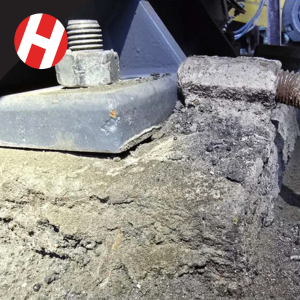
Visible foundation damage is an obvious issue. Cracks, crumbling concrete, or deteriorating grout are clear indicators that the base is no longer providing proper support.
In many cases, the less visible symptoms are treated individually instead of identifying the root cause.
Common Base-Related Issues
Several recurring issues drive most base-related failures:
- Soft Foot – When one or more mounting feet do not sit evenly, the equipment distorts when bolted down. This leads to vibration, bearing failure, and even winding damage due to heat stress.
- Loose or Weak Foundations – Loose mounting hardware, degraded grout, or poor installation can allow movement during operation. This increases instability and can ultimately lead to equipment failure.
- Baseplate Distortion – Improper leveling or poor grouting can distort the baseplate itself, creating stress points and misalignment across the system.
- Improper Adjustments – Over-tightening or incorrect adjustment of motor bases can damage hardware and introduce additional stress into the system.
These are not rare issues. Knowing what to look for below your equipment will help prevent these issues from going undetected or being misdiagnosed.
Why These Issues Get Missed
Most maintenance programs focus on bearings, motors, pumps, and lubrication. While this list is essential, it is not complete.
Very few programs include routine inspection of the base or foundation. That gap matters.
Industrial manufacturers lose an estimated $222 billion annually due to maintenance-related costs, including downtime and lost production, according to 25 Manufacturing Facts that Spotlight the Future of U.S. Factories.
Many of those losses are tied to root causes that were never addressed, including base instability.
Using Technology to Identify Root Causes
Traditional inspections are important, but they don’t always tell the full story. Advanced diagnostic tools provide deeper insight into base-related issues.
In addition to using visual inspections in identifying a potential issue before it arises, these tools can also be helpful in clarifying the source of an existing issue.
- Vibration analysis identifies abnormal patterns and helps distinguish between mechanical faults and structural issues.
- Motion Amplification allows technicians to visualize movement in real time, making it easier to detect looseness, resonance, and base instability.
- Remote condition monitoring such as Skyler Rotate tracks conditions and vibration trends over time and can reveal gradual changes tied to base degradation or structural shifts.
These tools help move maintenance from reactive to predictive, catching issues before they escalate.
All Systems Go
Reliable equipment starts with a stable foundation.
If your facility is experiencing recurring vibration, alignment issues, or unexplained failures, the problem may not be in the motor or pump. It may be underneath it.
The HECO process helps our customers identify root causes, not just symptoms. From field service and alignment to predictive monitoring and equipment management, our approach focuses on improving long-term reliability.
If you’re ready to take a closer look at what’s happening below your equipment, contact HECO to schedule an on-site inspection and evaluation.
—
Sign up for HECO’s enews updates in the sidebar to be notified of future blog posts and resources, including part 2 of this series, Six Steps to Prevent Failures.
Posted in Field Service, Repair