Improve Your Pump Performance with Curves, Controls, and More
March 18, 2026
When it comes to pump performance, efficiency is more than a bonus—it’s essential. At HECO, we’ve seen time and again that the way a pump operates in the system has just as much impact on reliability as the quality of the pump itself.
Whether you’re managing a vertical turbine setup in a utility plant, maintaining ANSI process pumps in a manufacturing environment, operating submersibles in a water processing operation, or utilizing pumps in various industrial applications, understanding the relationship between your pump curve and system curve is the key to preventing vibration, inefficiency, and premature failure.
Identifying the Specification Overlaps
Every pump is designed to perform within a specific range.
The pump curve, provided by the manufacturer, is a graphical representation of the performance of a given unit. It predicts how the pump behaves at different combinations of flow and head (pressure) based on its power and efficiency.
While the dimensional sizing of two pumps might match from one application to another, their respective pump curves will likely be totally different.
The system curve shows the head required by the system at various flow rates, factoring in static lift, pipe friction, and other losses.
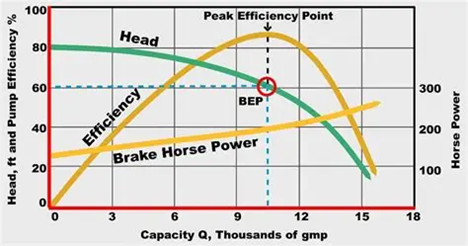
Where the pump and system curves intersect determines your operating point. Ideally, this intersection should be near the pump’s Best Efficiency Point (BEP). Operating your pump within 10% of its defined BEP allows you to minimize vibration, wear, and energy consumption while increasing the unit’s reliability and longevity.
Operating off-curve, especially far from BEP, can lead to a host of problems, including:
- Low-flow conditions leading to recirculation, overheating, and excessive vibration.
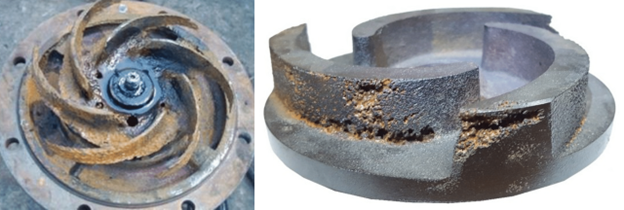
- High-flow conditions promoting cavitation, erosion, and bearing wear.
- Off-design loading which increases amp draw and the risk of motor overload.
In short, the pump may be running, but it’s not running well.
Understanding the Impact of Change
Motor horsepower matters, too. If system resistance increases but the pump operates beyond its BEP, even a higher-horsepower motor can overheat or fail if it’s consistently overloaded. That’s why it’s important to monitor amperage, align motor sizing with system demands, and keep an eye on conditions over time. This is especially critical if system requirements evolve over time.
The Affinity Laws remind us how sensitive pump systems are to change and the multiple issues that a single operating change could cause.
For example:
- By doubling the motor speed, flow doubles, head quadruples, and power demand jumps 800%.
- By increasing impeller diameter by 10%, flow increases ~10%, head by ~21%, and power by ~33%.
Those are massive changes with major energy and wear implications.
Enhancing Control and Lifespan
Operating pumps with Variable Frequency Drives (VFDs) provides the precision needed to optimize performance. VFDs allow operators to match flow and pressure to real-time demand while reducing inrush current, extending mechanical life, and improving energy efficiency.
Operational benefits also include the reduced maintenance, greater process flexibility, and increased reliability.
Following Best Practices
Even the best system design can fall short without field service and predictive monitoring.
To be efficient from set-up to sundowning, a pump system needs:
- Proper base installation to minimize vibration.
- Precision motor and pump shaft alignment to avoid axial, radial, or angular variations.
- Route-based or remote performance monitoring using vibration analysis, thermal imaging, electrical testing, or IoT-enabled remote monitoring for real-time condition tracking, such as HECO’s Skyler Rotate.
These aren’t extras; they are must-haves for maximizing uptime and preventing costly surprises.
All Systems Go
At HECO, our team has decades of pump system experience from rebuilds and diagnostics to installation and condition monitoring. We don’t just repair equipment; we help optimize entire systems for performance, efficiency, and long-term reliability.
If your facility relies on pumps, schedule a field visit for help restoring balance and efficiency to your existing pump systems or designing the ideal pump and system curves necessary for your application.
Posted in Predictive