Want a Reliable Spare Management Program? Ask These Questions.
November 11, 2026
When a critical motor or piece of rotating equipment fails, having a spare can help your facility avoid extended downtime. But what happens if you can’t find that spare or it isn’t ready for service?
Industrial facilities invest significant resources in spare equipment to protect their operations. However, purchasing a spare is only the beginning. Improper storage, inadequate maintenance, incomplete records, or missing components can create problems when it’s finally needed.
How confident are you that the equipment sitting in storage today could go into service tomorrow?
HECO believes a reliable spare equipment strategy starts with asking the right questions about how your equipment is managed, controlled, and maintained.
How Is Your Equipment Being Stored?
The environment where your spare equipment is stored can affect its condition and long-term reliability.
Motors and rotating equipment should be protected from moisture, contamination, and other environmental conditions that could affect their components. Storage facilities should also have the space and lifting capabilities needed to safely handle equipment of different sizes.
When evaluating a storage facility, consider:
- Is the environment heated, clean, and dry?
- Is equipment appropriately protected during long-term storage?
- Can the facility safely handle the size and weight of your assets?
- Is equipment organized for efficient access and retrieval?
These considerations become especially important for large industrial motors that require specialized handling and may remain in storage for several years.
What Happens While Your Spare Is in Storage?
Even when a motor isn’t operating, its condition can change over time. Bearings, insulation systems, and other components may require attention to help preserve equipment readiness.
A good storage program should include appropriate inspection, maintenance, and testing practices rather than simply placing equipment on a shelf.
Ask your storage provider:
- Is equipment inspected and tested before entering storage?
- Are electrical tests performed periodically?
- Are shafts turned according to applicable maintenance requirements?
- Can full-voltage test runs be performed when necessary?
- Are critical assets evaluated regularly to confirm their condition?
At HECO, our Equipment Management System (EMS) includes acceptance testing, periodic electrical testing, and shaft turning. Full-voltage test runs are also available upon request.
These activities help identify potential concerns while equipment is in storage, allowing maintenance teams to address them before the spare is needed.
The goal is to preserve equipment readiness throughout storage, not simply protect the equipment from physical damage.
Do You Know What You Have and Where It Is?
When equipment fails, your maintenance team shouldn’t have to search through spreadsheets, contact multiple facilities, or track down missing information to locate the correct spare.
An effective storage program should maintain accurate records of equipment locations, specifications, maintenance activities, and Repair history.
It should also have established processes for tracking equipment as it enters and leaves storage, maintaining appropriate inventory levels, and replacing spares after they’re put into service.
For facilities with multiple plants, centralized Equipment Management can provide greater visibility into available inventory and help reduce unnecessary duplication.
HECO’s EMS helps customers organize equipment information and maintain records that support more informed maintenance and inventory decisions.
Are You Storing the Right Equipment?
Having spare motors available is important, but maintaining the right inventory is equally critical.
Not every motor requires a dedicated spare. Equipment criticality, replacement lead times, and the consequences of an unexpected failure should influence which assets a facility keeps in storage.
An effective Equipment Management program should help answer questions such as:
- Do you have adequate spares for your most critical equipment?
- Do you have spares for motors with long replacement lead times?
- Are you storing equipment that’s no longer needed?
- Could one spare serve multiple applications?
- Are your minimum and maximum inventory levels appropriate?
HECO helps customers evaluate these questions through plant surveys, inventory recommendations, and identification of long-lead-time and cross-over assets.
These evaluations can help facilities reduce unnecessary inventory while maintaining access to equipment that supports their reliability goals.
Manage. Control. Maintain.
HECO approaches spare equipment storage through three interconnected activities: managing inventory, controlling equipment movement and availability, and maintaining asset condition.
Our Equipment Management System combines inventory planning, equipment records, maintenance, testing, and storage to help customers keep critical spares ready for service.
To support these capabilities, HECO recently expanded its storage capacity with a new 38,000-square-foot warehouse in Battle Creek, Michigan.
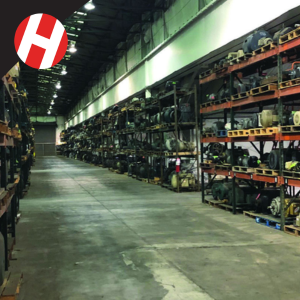
The heated facility offers additional space for storing electric motors and other rotating equipment, with heavy-duty lifting capabilities up to 40 tons to accommodate large industrial motors.
The expansion also provides customers with another option for storing critical spares without occupying valuable floor space at their plants.
The Battle Creek location is in addition to HECO’s existing storage facilities in Michigan, including Kalamazoo, Detroit, and Dearborn.
Storage Facilities in other states include:
- Wheeling, West Virginia.
- Lima, Middletown, Coshocton, and Mansfield, Ohio.
- Butler, Pennsylvania.
Combined with HECO’s Repair, Field Service, Predictive, and Product Sales capabilities, our Equipment Management System helps customers address equipment needs throughout its service life, from storage and maintenance to Repair and replacement.
All Systems Go
The worst time to discover that a spare motor is missing, damaged, or not ready for service is when your operating equipment has already failed.
Before that happens, take a closer look at your current storage practices. Do you know what equipment you have, where it’s located, how it’s being maintained, and whether it’s ready when needed?
Contact HECO for help evaluating your spare inventory, identifying opportunities for improvement, and developing an Equipment Management strategy that supports your facility’s reliability goals.
Posted in Equipment Management